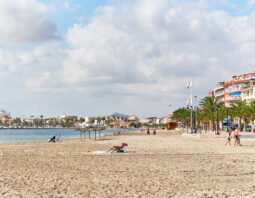
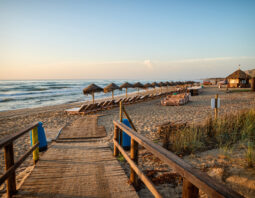
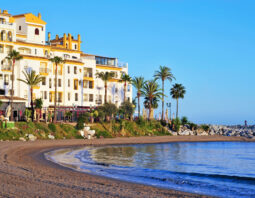
The Costa Cálida is the coast of the Region of Murcia, stretching 250 km from north to south, from El Mojón beach on the border with the province of Alicante to Los Cocedores beach on the border with the province of Almería. Plenty of sunny days and rare rain, with an average annual temperature above 18°C, are the hallmarks of this part of Spain’s Mediterranean coast.
Costa Cálida means “warm coast” in Spanish, and the name is entirely accurate: the water temperature here is on average five degrees higher than in other coastal regions. The hottest and most unusual corner of the Costa Cálida, in turn, is the Mar Menor, the largest saltwater lagoon in Europe, covering an area of about 170 km². Its maximum depth is only 7 m. The lagoon is semicircular and is separated from the Mediterranean by a sandbar 22 km long and between 100 and 1,200 m wide. Along the shores of the Mar Menor, 73 km of beaches stretch out, with clear water that warms up early in the year and almost no waves.
The Costa Cálida is more than just a coastline: it offers varied landscapes, nature parks and protected areas, superb food, and excellent beaches, many of them awarded the Blue Flag and the “Q” quality mark for cleanliness and service. It is also a paradise for water sports lovers: there are numerous diving, windsurfing and sailing schools, as well as training centres for professional athletes.
How to get to the Costa Cálida?
The Costa Cálida is easy to reach by car, both from the north (through the Valencian Community on the AP-7 motorway towards Cartagena or on the N-332 national road) and from the south (from Andalusia on the AP-7 motorway towards Cartagena). The Region of Murcia also has its own international airport, Aeropuerto Internacional de Murcia (RMU). A larger airport is located in the neighbouring province of Alicante.
You can also take the train to Murcia or Cartagena and then change to commuter trains or buses to the resorts on the coast itself: La Manga del Mar Menor, Mazarrón, Águilas, San Pedro del Pinatar and others.
Climate and landscape
The Costa Cálida is a fairly hot and dry coast. Compared with the neighbouring Costa Blanca, it has higher temperatures and less rain. The climate is closer to subtropical than Mediterranean. The average annual temperature is +18°C, and the hot summers and mild winters are full of clear, sunny days with not a cloud in the sky from horizon to horizon.
The Costa Cálida has a varied landscape. The coastline is a succession of rocky cliffs, coves, sandy beaches and sheltered bays. On the whole, the coast has a dry, rocky terrain. There is a marine reserve near Cabo de Palos. There are also protected areas in the municipalities of San Pedro del Pinatar (Parque Regional de las Salinas y Arenales de San Pedro del Pinatar) and La Manga (Parque Regional de Calblanque, Monte de las Cenizas y Peña del Águila). Particularly worth a visit are the Mirador del Águila viewpoint near Portmán and the Mirador de Roldán south of Cartagena, the Sierra de la Muela, Cabo Tiñoso y Roldán mountain range, the Cabo Cope y Puntas de Calnegre Regional Park (Parque Regional de Cabo Cope y Puntas de Calnegre) and the Cuatro Calas (“Four Coves”) protected area.
The main natural attractions of the Costa Cálida
Let us begin our journey along the Costa Cálida with the salt lagoons of San Pedro del Pinatar. The Salinas y Arenales Regional Park (El Parque Regional Salinas y Arenales de San Pedro del Pinatar) is a wetland that serves as a nesting and resting place for many bird species, including flamingos. The park lies between the municipalities of San Pedro del Pinatar and San Javier and covers 856 hectares, including 6 km of Mediterranean coastline. Salt is extracted here, and for lovers of peloid therapy and mud baths there are convenient walkways along the Camino Quintín promenade.
The Calnegre y Cabo Cope Regional Park (El Parque Regional de Calnegre y Cabo Cope), covering about 1,100 hectares, is another excellent place for walks. It is located in the municipality of Águilas. One of the best times to visit is late winter to early spring, when the shrubs are in bloom and the air is filled with the song of birds that have started nesting. The park’s geological diversity has produced a variety of landforms, from steep cliffs to fossilised sand dunes.
The Sierra de las Moreras protected area in Mazarrón is a mountain range rising on the shore of the Mediterranean. Gypsum was once mined in this part of the coast, and today you can still find old gypsum quarries and kilns here. Lovers of mountain walking or cycling will enjoy magnificent views. But the municipality’s main attraction is in the small resort village of Bolnuevo. This is the Gredas de Bolnuevo, a unique rock formation that erosion has shaped into fantastic forms, most of all resembling a clearing of giant mushrooms. Holidaying on the Costa Cálida without stopping in Bolnuevo would be a great omission.
The Cuatro Calas protected area (El Paisaje protegido Cuatro Calas), whose name means “four coves”, lies right on the border of the region with neighbouring Almería. It covers about 222 hectares, where low hills covered with feather grass alternate with dry riverbeds and ravines, including the Cañada Brusca salt marsh. Rare species of plants and animals are found here; among the latter, the spur-thighed tortoise and the red-tailed lizard stand out.
Calblanque Nature Park (El Parque Regional de Calblanque) lies between Cabo de Palos and Portmán, near Cartagena. This natural spot boasts a great variety of landscapes: Aleppo pine forests, scrubland, dry riverbeds, sandy plains, dunes, fossilised dunes (palaeodunes), coves and rocky cliffs. The park also contains the Rasall salt flats, a Mar Menor wetland bird protection area. Access to the park for private vehicles is restricted. Numerous routes have been laid out for visitors, and viewpoints have been set up.
In the central part of the coast, a massive rock rises above the waters of the Mediterranean, home to another regional park: Sierra de la Muela, Cabo Tiñoso y Roldán (Sierra de La Muela, Cabo Tiñoso y Roldán). The park, established in 1992, is not far from Cartagena. Its beaches, cliffs and small picturesque coves create varied scenery. At Cabo Tiñoso there are the remains of an old artillery battery and of the 16th-century Santa Catalina watchtower.
The Region of Murcia as a whole, and the Costa Cálida in particular, offer around a hundred fascinating routes for walkers. You can walk for hours along the old miners’ and fishermen’s paths that run along the coast between Cabo de Palos and Portmán, between Cartagena and the Bay of Mazarrón, or in the Calnegre y Cabo Cope Nature Park, enjoying panoramic views of the sea and the resort villages. The greenways laid along former railway lines, adapted and equipped for walking or cycling, are also interesting. On the coast, 2 routes are particularly interesting: the Vía Verde de Mazarrón and the Embarcadero del Hornillo in Águilas.
The main resort towns of the Costa Cálida
In the northern part of the Costa Cálida lies San Pedro del Pinatar, a small resort town whose main attraction is the Salinas y Arenales Regional Park, where you can watch flamingos and other birds in their natural habitat. The Lo Pagán area, right on the shore of the Mar Menor, is of special interest to visitors: it has the town promenade, areas for mud baths and sandy beaches that are perfect for family holidays. Those who like an active holiday can enjoy water sports such as kayaking, windsurfing and sailing. Along the promenade there are numerous cafés, bars and restaurants whose terraces offer panoramic views of La Manga.
South of San Pedro is Los Alcázares, a cosy town whose calling card is 7 kilometres of magnificent sandy beaches and an equally magnificent promenade. Las Salinas beach, awarded the Blue Flag for cleanliness and quality of service, is particularly popular. Water sports are also available here for active holidaymakers, and on the outskirts there is the excellent La Serena Golf club. In addition, Los Alcázares hosts the annual Gastromar food festival, which attracts gourmets from all over Spain.
One of the most unusual resorts in the Mediterranean is La Manga del Mar Menor. The town stretches along a narrow 22 km sandbar separating the Mediterranean Sea from the Mar Menor. In some places the sandbar is several hundred metres wide, in others barely a couple of dozen. The Mar Menor is a lagoon whose maximum depth does not exceed 7 metres. Its water quickly warms up to record high temperatures, and there are almost never any waves. The Mediterranean on the other side of the sandbar, on the contrary, is always cooler and deeper, with frequent waves. Residents and holidaymakers can choose where to spend the day depending on the weather. When it is calm, many head to the Cabo de Palos area, where the picturesque coves are perfect for snorkelling or scuba diving, and the seafood restaurants are ready to impress the most demanding diners. The port of La Manga offers opportunities for sailing and boat trips. South of the sandbar lies Calblanque Nature Park, with dunes and clean, wild beaches untouched by civilisation, an ideal place for nature lovers and walkers.
Cartagena is a port city with a history of more than 2,000 years. For centuries Cartagena served as a strategic port on the Mediterranean. Today, many surviving historic monuments recall its rich past. Cartagena’s crowning jewel is the Roman Theatre, discovered in 1988 and dating from the 1st century BC. Nearby are the remains of the forum and ancient baths. One of the most picturesque places in Cartagena is the waterfront. A wide promenade with palm trees, fountains and sculptures runs along the old port, where naval vessels and cruise ships still moor. Here you can also visit the ARQVA Museum of Underwater Archaeology, which displays unique finds raised from the seabed, including Phoenician and Roman artefacts. If you are interested in military history, be sure to visit the Naval Museum. Cartagena also has the Regional Museum of Modern Art, the Civil War Museum, the Archaeological Museum, the Ethnographic Museum and several other interesting museums and exhibition centres. Above the city rises Concepción Hill, crowned by a medieval castle. You can climb the hill on foot along a scenic path or take the panoramic lift. On the hill there is a city park with shady avenues and viewpoints offering breathtaking views of the port, the Roman Theatre and the rooftops of the old town.
Puerto de Mazarrón is another attractive seaside town with an unhurried pace of life: calm and comfortable, with a long promenade and many natural attractions nearby. The main attraction that made this corner famous, however, is the Gredas de Bolnuevo, a few kilometres to the south: fantastic rock formations created by wind and water over many thousands of years. These golden “stone mushrooms” and whimsical shapes created by nature form a fairy-tale landscape that attracts photographers from all along the coast. You can also visit the Santa Elena watchtower, on a headland on the opposite side of the Bay of Mazarrón, which offers panoramic views of the coast. The beaches of Puerto de Mazarrón are among the best on the Costa Cálida. Many of them have been awarded the Blue Flag. The beaches and small, crystal-clear coves are also suitable for diving. In the town and its surroundings there are several schools and centres offering dives at the most interesting spots. The seabed off the coast of Mazarrón is considered one of the most picturesque in southern Spain.
Águilas is the southernmost resort of the Costa Cálida, on the border with Almería. The main local attraction is the Cuatro Calas nature park, with its picturesque beaches and footpaths. In total, more than 30 beaches stretch along the municipality’s coastline, from wide town beaches to tiny wild ones hidden in rocky coves. On the El Roncador headland stands the old San Juan de las Águilas castle, built in the 18th century on the site of an older fortification from the time of Arab rule. From the top of the castle there are stunning views of the town, the sea and the coast. At the foot of the rock, almost at the water’s edge, there is a working lighthouse.
The best beaches of the Costa Cálida
The 250 km of the Costa Cálida coastline are a succession of steep cliffs, picturesque secluded coves and comfortable sandy beaches with crystal-clear water. The warmest coast of the Spanish Mediterranean is perfectly suited to beach holidays. The best beaches of the Costa Cálida include:
- Playa Carolina (Águilas). This beach is in the Cuatro Calas (“Four Coves”) nature park, on the border with Almería. Many consider it the last unspoilt corner of the Mediterranean in the Region of Murcia. La Carolina beach stands out for its soft, pale sand and easy access: compared with the park’s other coves (Calarreona, Higuerica, Cala Cerrada and Los Cocedores), it is the easiest to reach.
- Cala de Calnegre (Lorca). Another beach untouched by civilisation, located within the Sierra de la Almenara, Las Moreras and Cabo Cope nature park. Cala de Calnegre has received the Ecoplayas award for its unspoilt natural beauty.
- Playa de Calblanque (Cartagena). Between the municipalities of Cartagena and La Unión, within the nature park, lies a true natural gem: a secluded cove with soft golden sand and crystal-clear water. There are no large-scale developments, noisy promenades or hotels nearby. Pristine beauty, wild nature, clean water, a sea breeze, peace and quiet: it is the ideal place for those seeking seclusion.
- Playa de Bolnuevo (Mazarrón). This beach with warm golden sand is in the village of Bolnuevo, south of the centre of Mazarrón. It is perfect for family holidays: the water deepens gently and the waves are usually quite moderate. The real highlight of this place is the impressive natural rock formations right by the sea, the famous Gredas de Bolnuevo, which create surreal views. Bolnuevo beach is a landscape you cannot mistake for any other, one of the most photographed places in Mazarrón and an iconic symbol of the whole Costa Cálida.
- El Hornillo (Águilas). This attractive crescent-shaped beach overlooking Isla del Fraile is suitable for both swimming and snorkelling, thanks to its very picturesque underwater rocky areas and varied marine flora and fauna. At the southern end of the beach there is a concrete and stone platform, an old pier used in the early 20th century to load ships with minerals mined in various parts of the region.
- Playa Paraíso (La Manga). The name means “Paradise Beach”. It is a whole kilometre of fine sand and warm shallow water. Despite being close to residential areas and hotels, the beach is rarely crowded. Cafés, restaurants and small shops are within walking distance. From here it is also easy to reach Calblanque Nature Park or the lighthouse and rocky coves of Cabo de Palos.
- La Playa Amarilla (Águilas). A small cove with bright yellow sand that makes it stand out from the other beaches of the Costa Cálida. The beach is directly opposite Isla del Fraile, which is part of the Cabo Cope y Puntas de Calnegre nature park. It is not only a picturesque spot but also a protected area for rare bird species. The view of the island and the bay is simply stunning, especially at sunrise or sunset, when the water takes on copper and blue tones. The distance from the beach to the island is only about 50 m, and the depth along this stretch is about 1.5 m. On days when the sea is calm, you can swim to Fraile and see the coast from an unusual angle.
Food of the Costa Cálida
The cuisine of the Costa Cálida is very varied. Fresh fish and seafood hold a place of honour in the regional cuisine, along with rice and seasonal vegetables.
The main dishes you should definitely try:
- Caldero del Mar Menor. This is a traditional dish of the local fishermen: a thick rice soup made with a stock of various kinds of fish, especially small rockfish, and seasoned with ñoras (dried sweet peppers). It is served with pieces of fish, fresh crusty bread and alioli sauce.
- Zarangollo. A simple but tasty dish of fried courgettes, onions and eggs. Aubergines or potatoes are sometimes added. It is often served as a side dish or starter.
- Michirones. A hearty dish of dried broad beans cooked with ham, chorizo, bay leaf and spices.
Traditionally served in clay pots, like a stew. - Pastel de carne (Pastel de carne murciano). A meat pie filled with beef, chorizo sausage and eggs with spices, baked in puff pastry. It has Arab roots and is a popular dish in the region.
Salads and vegetable dishes:
- Murcian salad (Ensalada murciana). A salad of tinned tomatoes, tuna, boiled eggs, onion and black olives, dressed with olive oil. It is often served chilled in the summer months. You will often find it in cafés and restaurants on the neighbouring Costa Blanca too, as the salad is very tasty and hugely popular.
- Pisto murciano. A vegetable stew of tomatoes, peppers, onions and aubergines fried in olive oil. Eggs are sometimes added. It is served both hot and cold.
Desserts and sweets:
- Paparajotes. A traditional dessert of lemon tree leaves fried in batter and then sprinkled with sugar and cinnamon. The leaves themselves are not eaten, but they give the batter its special aroma.
- Cordiales de almendra. Almond paste biscuits filled with pumpkin jam, traditionally made at Christmas.
- Pan de Calatrava. A dessert similar to flan (egg custard), made from stale bread, eggs, milk and caramel.
Local wines also deserve a mention. Murcia is famous for its winemaking, centred in Jumilla, Yecla and Bullas. Both the red and the white wines produced in the region deserve every praise. The region’s top ten wines include:
- Casa Castillo Monastrell Pie Franco (Jumilla).
- Bodegas El Nido ‘El Nido’ (Jumilla).
- Casa Castillo Cuvee N Viñas Viejas (Jumilla).
- Bodegas Cerrón ‘El Cerrico’ Fermentado en Ánfora Airén (Jumilla).
- Casa Castillo Las Gravas (Jumilla).
- Bodegas Cerrón ‘Los Yesares’ Monastrell (Jumilla).
- Bodegas El Nido ‘Clio’ (Jumilla).
- Elo Monastrell (Yecla).
- Bodegas Cerrón ‘La Calera del Escaramujo’ Monastrell (Jumilla).
- Bodegas Olivares Dulce Monastrell Ungrafted Old Vines (Jumilla).