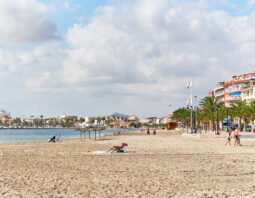
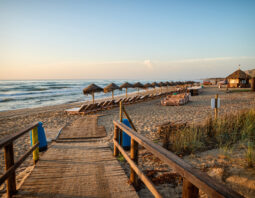
Jávea (Jávea in Spanish, Xàbia in Valencian) is a small resort town in the northern part of the Costa Blanca, in the comarca of Marina Alta. Jávea lies roughly halfway between Alicante (86 km) and Valencia (113 km) and their international airports. On clear days you can see Ibiza from the Jávea coast: the island, 90 km away, is a quick ferry ride from the port of neighbouring Dénia.
General information about Jávea
Jávea stretches along the shore of a large bay and covers an area of around 420 square kilometres. The town is sheltered from cold winds and rain by two high rocky headlands, Cabo de San Antonio and Cabo de la Nao, and by Montgó mountain (753 m), which also give the town and its surroundings a particularly mild microclimate. It is no accident that the World Health Organization gave Jávea the status of the town with the most favourable climate in the world. Add beautiful countryside (Jávea is considered the greenest town on the Costa Blanca), woodland, blossoming gardens and farmland, and you get one of the most picturesque spots on the Alicante coast.
The coastline is Jávea’s calling card: over 20 km, sandy beaches alternate with picturesque rocky coves where you can swim, sunbathe and do all kinds of sports, including sailing, diving, windsurfing and more. Numerous walking and cycling routes run along the coast, and there are 15 viewpoints, each with breathtaking views of the sea and the coastline.
Cape La Nao (Cabo de la Nao / Cap de la Nau) is the easternmost point of mainland Spain, which is why Jávea is traditionally called “Spain’s sunrise”, Amanecer de España. The historic town centre is 2 km from the coast.
Distances from Jávea to the nearest towns and airports:
- Alicante-Elche International Airport: 98 km;
- Valencia International Airport: 119 km;
- Dénia: 11 km;
- Calpe: 27 km;
- Altea: 38 km;
- Benidorm: 46 km;
- El Campello: 76 km.
Jávea has bus connections with all the towns on the coast. You can also get to Alicante by the coastal tram, changing in Benidorm. Alicante also has the nearest major railway station.
For getting around by car, the Mediterranean motorway AP-7 (E15) and the N-332 road are ideal.
Population and weather in Jávea
According to the National Statistics Institute, Jávea had 28,731 residents on 1 January 2022. About 50% of the population are foreigners. In the summer season, tourists and holidaymakers swell the town’s population several times over. The largest community is British: you hear English in the town as often as Spanish. The German community is the second largest. In total, according to official statistics, more than 80 different nationalities live in the town.
Jávea has a classic Mediterranean climate with very mild winters (even on the coldest days the temperature does not drop below +10°C), pleasant spring and autumn weather and fairly hot summers. The average annual temperature is around +18°C. This part of the coast gets little rainfall: heavy but short downpours come once or twice a season. In August and September the sea near the shore warms up to almost +27-28°C.
History of Jávea
Jávea is one of the oldest towns on Spain’s Mediterranean coast. The earliest archaeological finds, made in the Foradada cave, date back 30,000 years (the Upper Palaeolithic). Ancient rock paintings, pottery remains and burials have been found around Jávea, most of them from the Neolithic, the Chalcolithic and the Bronze Age. The ancient Iberians left archaeologists a fascinating find: in 1904, excavations uncovered gold and silver objects dating from the 4th-2nd centuries BC, which became known as the “Iberian Treasure of Jávea”.
The Iberians were followed by the Romans. Under their rule Jávea became a fully fledged settlement, a trading port was built and trade links were established with other lands. The Romans were succeeded by the Muslims, who also left behind historical and architectural monuments and many place names, and the Muslims by the Christians. The latter, fleeing countless pirate raids, moved 2 km inland from the coast and surrounded the centre of the settlement with a protective stone wall. Today the remains of the old wall mark out the historic town centre.
The Christian era brought Jávea economic growth. Jávea was granted town status as early as the end of the 14th century. The raisin trade was highly profitable, the town grew, new houses went up quickly, and churches, monasteries and chapels were built. Residential construction peaked in the 19th century: by then a class of merchant bourgeoisie had fully formed in the town, and besides trading it played an active part in improving Jávea, building houses and palatial mansions (many of these buildings have survived in good condition to this day). Agriculture and fishing also flourished in Jávea. In the middle of the last century, tourism became the municipality’s main economic activity, and the construction sector soon received a boost as well.
Sights of Jávea
The historic centre of Jávea, which has kept the authentic atmosphere of old Spain, with its narrow streets and small traditional houses with whitewashed façades and stone trim huddled together, is the first place to start getting to know the town.
Jávea’s main architectural and historical monument is the Church of St Bartholomew (San Bartolomé), in the very centre of the town. It was built over the 14th-16th centuries and for many decades afterwards served not only as the centre of the townspeople’s religious life but also as a lookout over the coastline and a fortress protecting the congregation during pirate raids (the loopholes above the entrance are proof of this).
The town has another interesting church, Santa María de Loreto (Iglesia de Santa Maria de Loreto), built in modern times (1967). The church looks very unusual and resembles the hull of a ship. It was built on the foundations of an old chapel from 1914 that was almost completely destroyed during the Civil War. The church often hosts classical music concerts, as its unusual design gives it excellent acoustics.
Old buildings worth seeing have survived in Jávea and its surroundings:
- Palau dels Sapena, Casa dels Bolufer, Casa de les Primícies, Casa Arnauda, Casa de Montalbán and Casa Abadía;
- the town hall;
- the municipal market, Mercado municipal de Abastos, built on the site of an old monastery;
- the town library;
- the convent of the Discalced Augustinian nuns, Convento de las Agustinas Descalzas, built on the site of the Minim friars’ monastery destroyed during the Civil War;
- Casa de Tena, now used as an exhibition hall;
- the Chapel of St Anne (Capilla Santa Ana), formerly part of the town hospital built in the 16th century;
- the Chapel of Nuestra Señora de los Ángeles (Ermita de Nuestra Señora de los Ángeles), on the site of the old 14th-century Monastery of St Jerome.
Montaner town park has an interesting monument, Riurau dels Català d’Arnauda, a reminder of the days when producing and trading raisins was Jávea’s main economic activity. In the south of the town, on the La Plana hill, almost on the border of Montgó Natural Park, stand 11 old windmills dating from the 14th-18th centuries.
Among the museums, the “Soler Blasco” Museum of Archaeology and Ethnography is well worth a visit. It is housed in the palace house of Antoni Banyuls, and its collection is devoted to the history of Jávea.
Another of the town’s sights is the port, which has a fish market, and much of the catch sold there goes straight into the kitchens of Jávea’s best seafood restaurants. The port developed actively as a trading port from the early 16th to the late 19th century. This was when raisin production flourished in Jávea and trade with other lands was brisk. Gradually this industry declined and fishing took first place. And, as often happens, fishermen’s quarters soon grew up around the port, with small, almost toy-like houses and narrow streets and alleys.
Near the port is Jávea’s yacht club, which has a sailing school for children. You should also take a walk around the Duanes de la Mar quarter, one of the liveliest in town. This is the town’s food and shopping hub, with numerous bars, restaurants and shops.
Besides the old town and the port with its surrounding quarters, Jávea has another notable district, next to the town beach, El Arenal. The beach and the promenade running along it are a favourite place for locals and tourists to relax and stroll. The promenade also has plenty of interesting restaurants, tapas bars and cafés.
Natural parks and viewpoints of Jávea
Jávea is surrounded by natural parks and protected areas. To the north of the town lies Montgó Natural Park, covering more than 2,000 hectares, one of the most beautiful and picturesque on the Costa Blanca. Its mountain ridge shelters Jávea from the north wind. The highest point of the ridge is 753 m above sea level. Routes of varying difficulty cross the park, running past sheer cliffs, caves, majestic peaks and deep ravines. The park is home to more than 100 animal species and more than 600 plant species, many of them endemic and rare, and some even endangered.
The easternmost point of Montgó Natural Park is Cabo de San Antonio, whose waters are a marine reserve. The cliffs and seabed here are rich in flora and fauna, and many plant and animal species are classed as rare and protected.
Another micro-reserve lies around Portitxol bay. Rare endemic plants grow there. The viewpoints on this part of the Jávea coast offer the most beautiful views.
Another park lies south of Jávea: La Granadella forest park, which covers around 700 hectares and is also a nature reserve, home to many species of rare local plants.
As for viewpoints, Jávea has more of them than anywhere else on the Costa Blanca. Along the municipality’s 20 km coastline, which runs from north to south from the Tallada cave (Cova Tallada / Cueva Tallada) to Granadella cove (Cala de la Granadella), there are 15 viewpoints. There is even a dedicated route, the Ruta por los Miradores de Jávea, which is best done by car.
Jávea’s viewpoints in order from north to south: Els Molins, Cap de Sant Antoni, Punta de l’Arenal, Séquia de la Nòria, Cala Blanca, Caletes, Creu del Portitxol, L’Illa, La Falzia, Mirador del Cap Negre, Cap de La Nao, Pesqueres, Ambolo, Castell de la Granadella and Granadella.
Beaches of Jávea
Jávea’s coastline is a series of sandy and sand-and-pebble beaches and rocky coves.
Jávea’s beaches:
- El Arenal beach (Playa El Arenal). The main sandy town beach, 480 m long. The most popular place for locals and tourists to relax. It slopes gently into the sea, the water is shallow, and every year it receives the Blue Flag for cleanliness and quality. The beach has easy access ramps for pushchairs, drinking water fountains, children’s play areas, sports grounds and eco-toilets. In summer there are lifeguards on duty and first-aid posts, and sunloungers and parasols are available for hire.
- La Grava beach (Playa La Grava). A sand-and-shingle town beach, 290 m long. It is known for its crystal-clear water and for being uncrowded even in high season. It also receives the Blue Flag every year. In high season there are lifeguards on duty, a Red Cross first-aid post, and sunloungers and parasols for hire.
- Muntanyar I beach (Playa Muntanyar), also called Benissero. Jávea’s longest semi-urban beach: rocky for 1,600 m and shingle for 400 m. Water shoes are recommended for relaxing and swimming.
- Muntanyar II beach (Segon Muntanyar). A rocky semi-urban beach, 1,700 m long.
Jávea’s coves:
- Blanca (Cala Blanca). A sheltered cove with a 300 m rocky beach. An ideal place for diving and snorkelling, as there are no big waves.
- Pope and Tangó (Cala de Pope and Cala de Tangó). Two small, secluded rocky coves for those seeking maximum privacy.
- Sardinera (Cala Sardinera): a cosy cove with a 500 m rocky beach on Cap de Sant Martí.
- Granadella (Cala La Granadella). A very popular spot in Jávea: 160 m of sand-and-shingle beach and crystal-clear turquoise water. It is considered one of the most beautiful coves on the Costa Blanca. Every year it receives the Blue Flag for cleanliness and quality. From mid-June to mid-September there are lifeguards on duty, sunloungers and parasols for hire, and parking.
- Portitxol (Cala Portixol), also known as La Barraca. A beautiful rocky cove about 600 m long with views of Portitxol island.
- Ambolo (Cala Ambolo). A 300 m nudist beach with views of Descubridor island.
Property in Jávea
Jávea is one of the most expensive resorts on the Costa Blanca. In January 2023, the average price per square metre in the municipality was €3,240. The town and its surroundings are divided into 9 areas that differ greatly in type of housing and price:
- Centro Ciudad (historic centre and surrounding quarters): €2,287/m²
- Puerto (port area): €4,103/m²
- Partida Tosal – Zona dels Castellans (northern suburb): €2,557/m²
- Montgó – Ermita (north-western suburb bordering Montgó Natural Park): €2,948/m²
- Partida Comunes-Adsubia (western district of the town): €2,929/m²
- Montañar-El Arenal (town beach area): €3,627/m²
- Cap Martí – Pinomar (southern district of the town): €3,551/m²
- Portichol – Balcón al Mar (south-eastern suburb): €4,341/m²
- La Granadella – Costa Nova (the southernmost suburb, within La Granadella park): €4,000/m²
Finding a small home at a low price in Jávea is not easy. Studios and small one-bedroom apartments cost from €80,000, and the choice is limited. You need to look for such homes in the centre and in the El Arenal area. Apartments and bungalows with 2 bedrooms cost from €155,000. Townhouses, duplexes and semi-detached houses can be found in any area from €200,000. Small detached houses sell from €300,000. The areas to the north and south of Jávea that lie right by the sea or border the natural parks are the most expensive. They are built up mainly with detached houses, villas and country estates with large plots. The vast majority of these properties have panoramic views of the sea and the coast. Villa prices start at €450,000, villas with large plots and sea views at €950,000, and luxury villas at €2,000,000.
You can browse our selection of the best property in Jávea in our catalogue.