It sounds simple enough: “I want to buy a flat by the sea and rent it to holidaymakers. What licence do I need?” Let’s pause for a moment. Almost every word in that sentence needs some explanation, and the “licence” people usually have in mind does not even exist as a single standard document.
Let’s take it step by step. The rules have changed so often over the past year and a half that some online guides are already out of date.
What people mean by a tourist rental licence
There is no single document
Tourist accommodation in Spain is regulated by the regional authorities, not centrally from Madrid. Each autonomous community has its own legislation, register and requirements. In Spain, the usual term is “vivienda de uso turístico”, or VUT. International buyers often refer to a “tourist licence”. In some regions, that does mean a permit issued after an inspection. In others, including the Valencian Community, the process is based on a declaration made under the owner’s responsibility, and there is no approval stamp to wait for.
Three layers of rules apply at the same time
The first layer is national: it covers matters such as the Horizontal Property Act, guest registration and taxes. The second is regional: it defines tourist accommodation, sets property standards and explains how registration works. The third is municipal: it determines whether tourist rentals are allowed in a particular building, street or neighbourhood.
Meeting the requirements at one level does not guarantee approval at another. An owner may receive a regional registration number, only to find that the local council is no longer accepting new tourist rentals in that area.
Where tourism ends and ordinary rentals begin
In the Valencian Community, following the 2024 reform, a property is generally treated as tourist accommodation when it is rented for payment on a regular basis, is fully furnished and ready to occupy, is offered through tourist channels and is let for short stays of up to ten days. Longer stays are legally treated as seasonal rentals under Article 3 of Spain’s Urban Leases Act (LAU), so tourist registration is not required.
This should not be treated as a loophole. The purpose of the rental matters more than the wording of the contract. Simply calling a short-term tourist let a “seasonal rental” does not necessarily make it one in the eyes of the authorities.
Thinking about buying a property to rent out? Check whether it fits your plans and the local rules before you commit.
What changed in 2025 and 2026
The national registration number: introduced, then struck down
From 1 July 2025, properties advertised on Airbnb and Booking had to have a national registration number, known as the NRUA. Under Royal Decree 1312/2024, it was issued by the Land Registry. Owners faced long queues, refusals over discrepancies in cadastral records and weeks of correspondence with registrars.
Then, on 19 May 2026, the Supreme Court issued judgment 620/2026 and struck down the single-register procedure, ruling that the national government did not have the authority to create a register that overlapped with regional ones. The Valencian Community was among those that challenged the decree. The ruling was published in Spain’s Official State Gazette (BOE) on 8 June 2026.
The practical takeaway is this: the Supreme Court annulled the procedure under Royal Decree 1312/2024 for obtaining a single national NRUA through the Land Registry. This did not remove the requirement to register tourist accommodation with the relevant regional authority. EU Regulation 2024/1028, which has applied since 20 May 2026, requires a registration number to be shown in online listings where the property is subject to a registration procedure. In the Valencian Community, VUT registration remains mandatory, and listings must show the number issued by the regional register. Do not confuse the NRUA with the regional tourist accommodation number; check the current requirements for the property and the platform before publishing an advert.
If someone offers to “arrange an NRUA” for a separate fee, ask exactly which number and procedure they mean: the former national procedure has been annulled.
Owners’ associations now have a say
Since April 2025, changes to the Horizontal Property Act have required approval from three-fifths of the owners in a building before tourist rental activity can begin. The vote must represent three-fifths both of the owners and of their ownership shares. Previously, it was enough for the building’s bylaws not to prohibit tourist rentals. The owners’ association may also impose a surcharge of up to 20% on the property’s shared expenses.
For buyers, this means one thing: read the minutes of owners’ association meetings before signing. If the building has an active association, its decisions may determine whether your rental plans are viable.
For more on the practicalities, see our guide to property investment and rentals in Spain.
The process: from the property to your first guest
Start with the property itself
Registration begins with checking the property, not filling in a form. You will need the cadastral reference (referencia catastral), a document confirming that the home is fit for occupation (licencia de ocupación or an equivalent document), and proof that it meets regional requirements. These may cover furniture, appliances, bed linen and a first-aid kit—in short, everything a guest needs to arrive with a suitcase and settle in. If the property itself lacks the necessary paperwork, it will not pass registration.
Municipal approval and the owners’ association
The next step is crucial: obtaining a municipal report on urban planning compatibility. It confirms that tourist use is permitted for the building and location under the local planning rules. At the same time, obtain the owners’ association’s approval if required by law.
The application and registration number
The next step is to apply to the regional register, usually online. You declare that you meet the requirements listed above, receive a registration number and can advertise the property. The number must appear in every advert—not just on booking websites, but in other advertising channels too.
What happens after registration
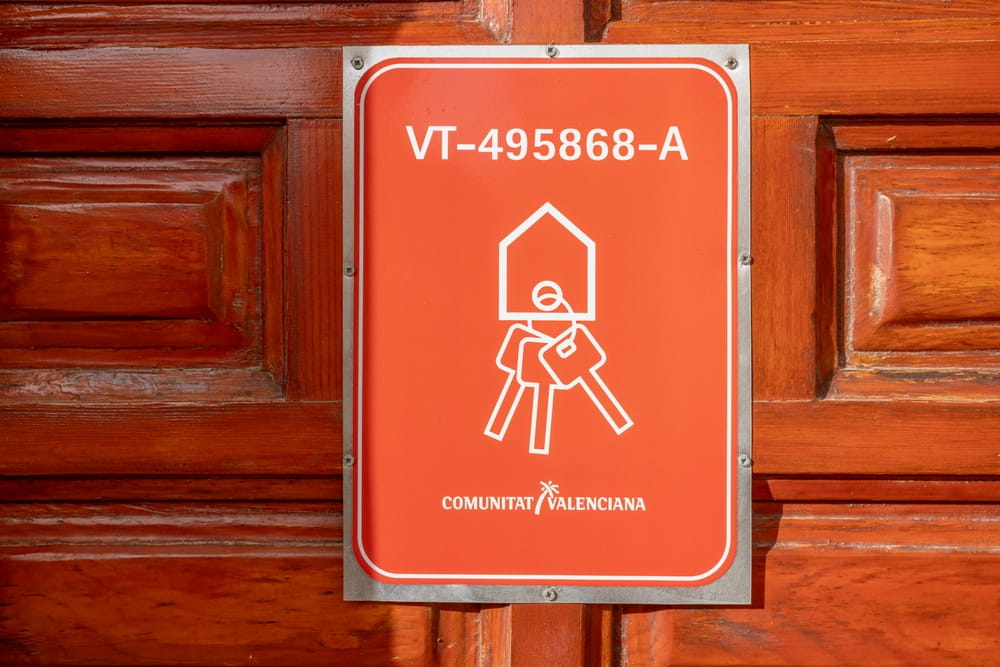
Getting the number is not the end of the process. You must register every guest and carefully submit their details through the traveller registration system, as required by Royal Decree 933/2021. Rental income must be declared separately, and in some regions, including the Valencian Community, the property must display an official sign. Fines for breaches in the Valencian Community can reach €600,000. That figure is set out in the legislation; it is not just a scare tactic.
The Valencian Community: its own rules
It is a declaration, not a licence
The Generalitat does not issue tourist rental licences. Instead, owners submit a *declaración responsable*—a declaration of responsibility—free of charge through the online platform, and the property is entered in the Registro de Turismo. The activity is considered authorised from the moment the declaration is submitted. That may sound straightforward, but the responsibility rests with you: if you provide incorrect information, you are accountable, not an official who may not have checked it.
The application must include the cadastral reference, a document confirming that the property is fit for occupation and a municipal report. The report can also be obtained from an accredited body known as an ECUV. Only the entire property can be rented out; renting individual rooms is not allowed. The owner is also responsible for identifying the person who actually manages the rental.
The 2024 reform and 2026 amendments
Decreto-ley 9/2024, which came into force in August 2024, introduced a major change: registration is no longer permanent. It now lasts five years. To renew it, you must submit a new application and an updated municipal report during the month before it expires. If you do not renew it, the property is removed from the register. For properties registered earlier, the five-year period runs from August 2024.
Another complication came in mid-2026. Law 3/2026 of 29 June required owners to obtain the owners’ association’s express approval before registering a property, rather than relying on the absence of a ban in the building’s bylaws. Properties registered before Decreto-ley 9/2024 do not need to provide this approval when renewing. The rules were amended again in the summer under Law 5/2026, so check the current wording before applying. Spanish regions continue to revise their rules frequently.
Valencia city: three limits
On 31 March 2026, Valencia City Council’s plenary session approved new rules, replacing the nearly two-year moratorium on tourist rental licences. Three limits now apply at the same time. The total number of tourist beds, including hotel beds, may not exceed 8% of the neighbourhood’s population. Tourist apartments may account for no more than 2% of the housing stock in a neighbourhood. On the ground floors, they may occupy no more than 15% of the premises on a block.
If any one of these three limits is reached, no new approvals will be issued—even if the other two thresholds are still some way off. According to market analysts, around ten neighbourhoods have already reached their limits, including Grao and Cabanyal. Check the specific neighbourhood, and sometimes the individual block, rather than relying on city-wide figures.
Alicante and the coast
In the province of Alicante, the rules vary from one municipality to another. Some councils restrict tourist rentals only in areas considered saturated; others apply the region-wide rules. There is no single answer that works everywhere. The practical approach is to request a report from the town hall responsible for the property and not rely on generalisations about the area.
Browse properties in different parts of Spain and compare options for living or investment.
What to check before you buy
“The property has a licence”
If a seller tells you this, ask for the number and look up the entry in the regional register. Check the registration date, expiry date and owner details. A change of ownership will usually require a new registration, so a “licence” does not automatically transfer to the buyer with the keys. Sellers do not always mention this.
Questions that can save you a lot of trouble
What do the owners’ association minutes say about tourist rentals? Has the neighbourhood reached any of its limits? Does the property meet regional requirements for floor area and equipment? How much rental income has it actually generated, and were the taxes paid? The more specific the answers, the fewer surprises you are likely to face after buying.
Since we have mentioned taxes, they deserve a closer look. Tax rules differ for residents and non-residents, so it is worth speaking to a *gestor*—a Spanish tax and administrative adviser—before welcoming your first guests. Our guide to declaring rental income and other taxes for non-residents in Spain is a useful starting point.
That covers the main points we wanted to explain. At Alegría, we will not promise to “get you a licence in a week”: in Spain, promises like that can end with an unwelcome letter from the town hall. We can, however, recommend the steps that actually help: view the property before you buy, read the owners’ association minutes, request a report from the relevant town hall and be prepared to hear if tourist rentals are not viable in that building. Sometimes the best advice is simply: “Let’s look at another option.”
Looking for property in Spain? Browse the current listings and check the permitted uses of each property before you buy.
FAQ
Is there a single tourist rental licence for all of Spain?
No. Tourist accommodation requirements are set at regional and municipal level. Depending on the region, the process may involve a permit or registration based on a declaration of responsibility.
Can I rent out just one room to tourists?
In the Valencian Community, tourist accommodation must be registered as a whole property; renting it by the room is not allowed. Check the rules in other regions separately.
Do I need approval from the owners’ association?
Starting tourist rental activity in a building may require prior approval from the owners’ association. Check the meeting minutes and current rules before buying.
How long does tourist accommodation registration last in the Valencian Community?
Under the rules described in this article, registration lasts five years. To renew it, you need to submit a new application and an updated municipal report within the required period.
What should I check before buying a property for tourist rentals?
Check the entry in the regional register, the registration period, municipal restrictions, the property documents and the owners’ association rules. Also clarify your tax obligations and how guest details must be reported.