When it comes to Spain and Spanish delicacies, the first thing worth mentioning, and the one that deserves rapturous praise, is jamón. Few meals go without jamón, yet it would be wrong to call it a festive delicacy: Spanish jamón is a snack, a filling for sandwiches and toast, an aperitif, a bite to go with wine and a dish in its own right served with melon, cheese, olives or olive oil. If you like, jamón fits naturally into breakfast, lunch and dinner, and most importantly, you never tire of it.
Jamón is probably the first thing every tourist who comes to Spain gets to know. More often than not, the journey into the world of Spanish delicacies begins with a gastronomic trio: jamón + dry red wine + cheese.
Jamón in Spain: what is it?
Jamón is dry-cured pork ham. It is specifically the ham, that is, the hind leg. The front legs have their own name: paleta. No self-respecting gourmet, or indeed any lover of Spanish delicacies, would ever confuse them. Nor should cured beef ham ever be called jamón: yes, the method is the same, but the product is completely different, with a different flavour and a name of its own, cecina.
Jamón is held in honour and respect in Spain: supermarkets give it a whole section, and in authentic bars and restaurants it becomes an essential part of the decor, with hams hanging from the ceiling and beams. Few tapas menus go without jamón. Jamón is also an essential part of the Christmas hampers that bosses give their staff in Spain.
For any Spaniard, jamón is not just cured pork but a source of national pride and personal devotion. It is no accident that the country even has a separate profession: the cortador, a professional jamón carver. After all, in the Spanish view, carving jamón properly is a serious science in its own right.
Spanish jamón: a little history

The history of Spanish jamón has its legends. The main legend says that ancient shepherds in the Pyrenees tasted the meat of a piglet that had drowned in a river rising from a salty mountain spring (after all, why let good food go to waste!). The salted meat tasted so good that they decided to cure it in salt from then on.
In real history, the Spanish, the Italians and the Croatians all compete for the title of inventors of cured pork ham. All of them are sure that even if they did not invent the delicacy themselves, they inherited the recipe and the method from the ancient Romans, preserved it and perfected it. One thing is certain: tasty, nourishing meat that keeps for a long time in almost any conditions became an essential part of the diet of travellers, explorers and soldiers.
How jamón is made in Spain
The making of jamón in Spain is standardised and divided into five stages:
- Initial salting with coarse sea salt and resting at a low temperature (0-4°C) and high humidity (75-95%).
- Before this, the excess fat is trimmed off the ham. This stage lasts from 5 to 14 days.
- Washing to remove the excess salt and hanging the hams vertically.
- Equalising the salt in special cellars or chambers at a set temperature (3-7°C) and humidity (70-90%). Over at least 40 days the salt spreads fully and evenly and the excess moisture is drawn out of the meat.
- Drying in a vertical position for several months. This takes place in two stages, with the temperature raised gradually and the humidity controlled.
- Maturing in the cellar for the rest of the time. It is at this stage that jamón acquires its distinctive taste, aroma, colour and texture. Jamón serrano matures for 10 months on average, jamón ibérico for up to several years. The period is set individually for each ham depending on its weight and quality, and the special microclimate of the cellars gives it its unique taste and aroma.
Experts judge whether a jamón is ready by its aroma, which they “listen to” after making two or three punctures with a special bone needle.
During curing, both the front and the hind legs lose about a third of their weight. The final product must meet the following requirements: at least 4.5 kg for jamón serrano, at least 7 kg for jamón ibérico and at least 3.5 kg for paleta.
Types of jamón in Spain
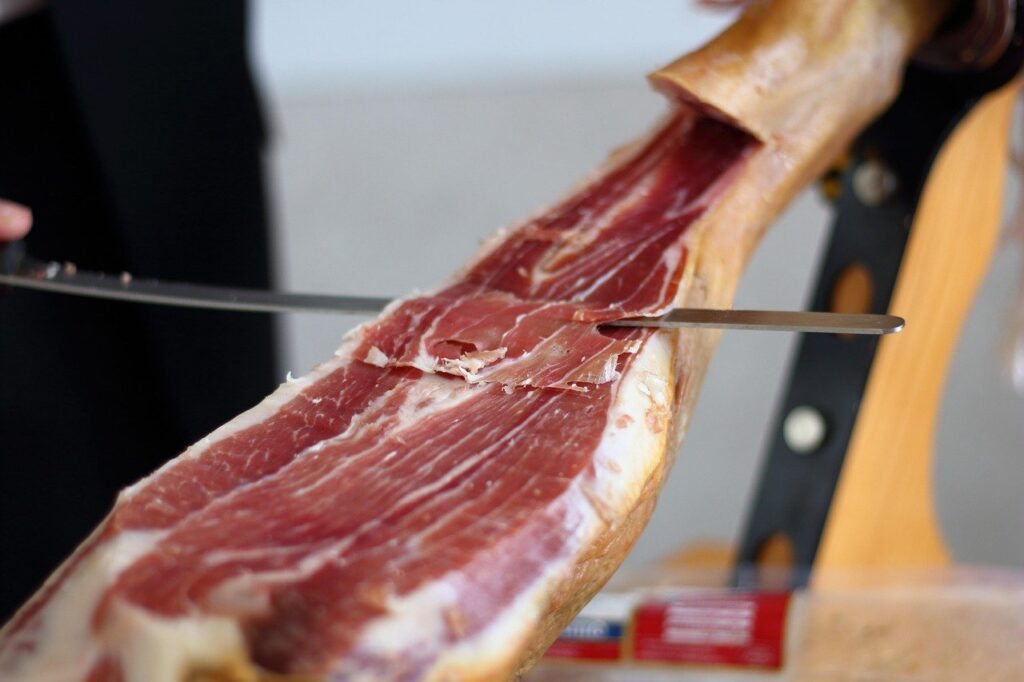
As we noted above, jamón in Spain is only ever the hind leg of the pig. Hind legs contain more fat, so the meat is more tender and tastier.
There are two main types of Spanish jamón: serrano and ibérico. The difference lies in the breed of pig.
Jamón ibérico is considered the most expensive and refined: it is made from a breed of black pig raised on the peninsula since ancient times. Pigs of the Iberian breed (“black pigs”) are either purebred or have only a minimal share of non-Iberian blood. The pigs roam freely on pasture rather than being kept in closed sheds. Ideally an Iberian pig’s diet should consist entirely of acorns (bellota), but in reality there are variations:
- Jamón de bellota: the most expensive type of Spanish jamón. For almost all of their 24 months of life, the Iberian pigs feed only on acorns from oak groves and fresh wild grasses.
- Jamón de recebo or Cebo de campo: in the final stage, other plant feed based on cereals and legumes is added to the pigs’ diet alongside acorns.
- Jamón de cebo (jamón de pienso): the pigs’ daily diet consists of ordinary plant feed (fodder) with a minimum of acorns.
Jamón serrano is less prized and cheaper, as it is made from crossbred pigs or from white pigs with no Iberian blood at all. “Serrano” means “from the mountains” in Spanish: the hams are cured in the mountains, that is, in special climatic conditions. Jamón serrano is usually divided into:
- Serrano Bodega (cured for 10 to 12 months).
- Serrano Reserva (cured for 12 to 15 months).
- Serrano Gran Reserva (cured for more than 15 months).
For both types, the pigs are raised for up to 24 months, less often up to 18. Curing takes no less time: for jamón serrano the periods are given above, while for jamón ibérico the minimum permitted period is 24 months, the average is 30 to 36 months, and for the most expensive types it is up to 48 or even 72 months.
The price of jamón in Spain
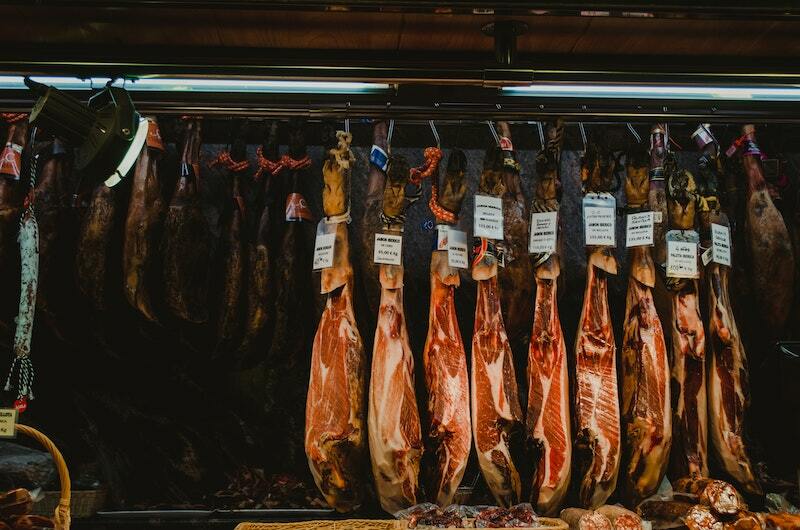
The price of jamón in Spain depends directly on its type and quality. The most expensive jamón is always Jamón Bellota made from purebred pigs of the Iberian breed (100% raza ibérica). Plant-based fodder and mixed breeds (for example, 50% raza ibérica) bring the price down considerably. The cheapest is jamón serrano, which is not really a delicacy at all.
Prices for paletas (front legs) start from €10/kg, for jamón serrano from €15/kg and for jamón ibérico from €30/kg.
There is no point looking for the most expensive types in supermarkets as factory-sliced, vacuum-packed products. This is not a mass-market product, so for the best jamón you should head to specialist shops, the Jamonería, shops selling cured meats and delicacies, and online gourmet food shops, where you can buy a whole ham.
The best jamón in Spain
The best jamón in Spain is the one labelled “Pata negra” or “Bellota”. Pata negra (“black foot”) is a variety of jamón ibérico. It is not a separate type or breed of pig. In general, in Spanish the phrase “Pata negra” is used for any product of the highest quality, so it is in effect a synonym for “top quality” or “extra”. And the pigs do not necessarily need to have black hooves or any other outward distinguishing features. A jamón that does not meet the “Bellota” criterion is unlikely to be labelled “Pata negra” by the producer.
The label “Pata negra” can be added not only to jamón but also to paleta, the front leg. In any case, remember: if the label says “Paleta Bellota 100% Ibérica Pata Negra” or “Jamón de Bellota 100% Ibérico Pata Negra”, both the front and the hind ham will be superb.
The most expensive type of Spanish jamón is produced in Huelva and costs €4,100 per ham. The producer is the family farm Dehesa Maladúa, which since the 1990s has been raising the rarest breed of Iberian pig, one that was on the verge of extinction: Manchado de Jabugo. 90% of its output is sold on the Spanish domestic market, and the remaining 10% is exported to Europe and Asia. The most refined Spanish jamón is matured for up to 72 months. You can buy this expensive Spanish jamón in delicatessens: ask for it or search online for Jamón Bellota 100% Ibérico Manchado de Jabugo.
The Guinness Book of Records includes a jamón of the “Sierra Mayor” brand costing about €12,000 per ham, also produced in Huelva from the rare Manchado de Jabugo breed.
If you are looking for the best Spanish jamón as a gift or for your own table, besides Dehesa Maladúa and Sierra Mayor, also look at the Joselito and Jamones 5J brands, whose farms are also in Huelva and whose entire output carries the quality and origin mark DO Jamón de Huelva. Top-quality Iberian jamón is also produced in three other regions: D.O. Guijuelo, D.O. Dehesa de Extremadura and D.O. Jamón Los Pedroches.
Where to buy Spanish jamón?
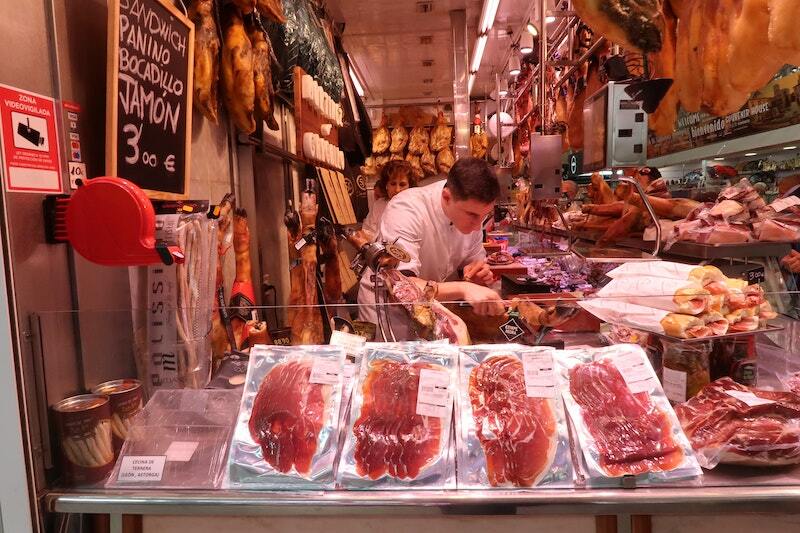
In Spain you can buy jamón in almost any shop. The most basic sliced jamón serrano is sold in every supermarket. Many shops have cold meat and cheese counters where you can choose a piece you like and ask for it to be sliced in front of you. There you can also buy a paleta or a whole hind ham.
For more expensive types, interesting brands, or simply for the special atmosphere, it is better to go to specialist shops, the Jamonería (as the name suggests, jamón is the star delicacy here), to delicatessens selling cured meats, the Charcutería, to municipal markets and to gourmet food shops.
And, of course, the widest range of jamón (sadly without the chance to taste it on the spot) is offered by online delicatessens.
How jamón is served in Spain
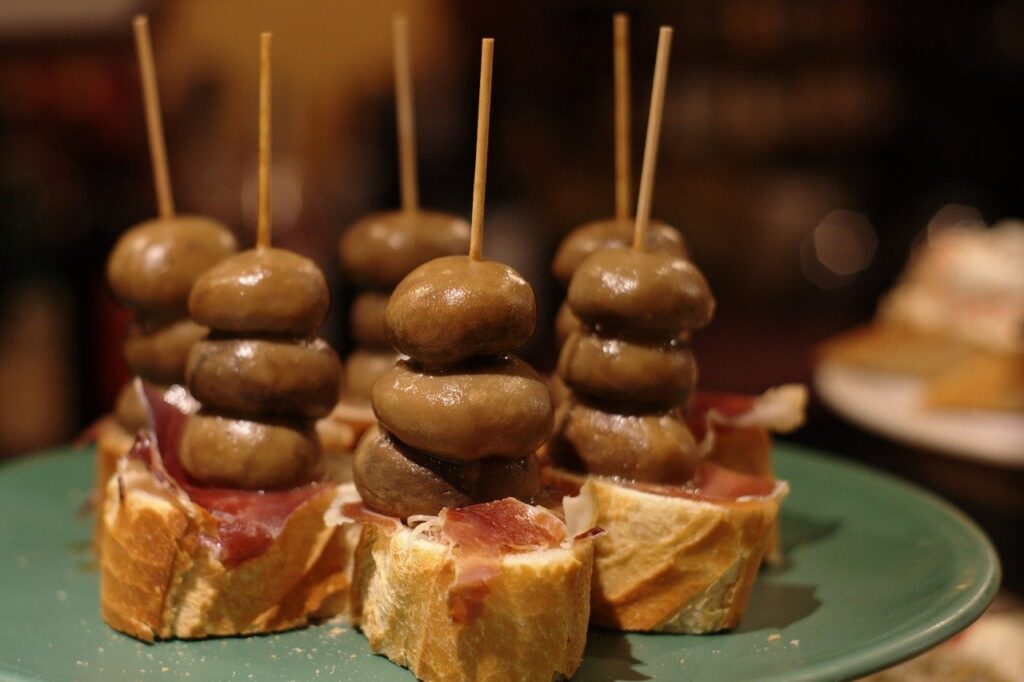
In Spain jamón is served thinly sliced. There is not only a special carving technique but also dedicated specialists, the cortadores, who can masterfully carve the ham into the thinnest, almost translucent slices that then melt in your mouth. Cortadores need only a minimum of tools for their work: first, a jamonera, the stand that holds the ham; second, a set of knives of different lengths and widths; and third, though not always, a protective glove, metal tongs and a towel.
Jamón is best served on a slightly warmed plate: this brings out its taste and aroma to the full. It can be served as a dish in its own right with wine or beer, or as part of mixed platters with various cured meats and cheeses. A wonderful combination is jamón with melon, which you will find on the menu of almost any Spanish restaurant. Jamón is also added to salads and soups (gazpacho, for example), and it goes perfectly with olives and olive oil, fresh vegetables and pasta. And, of course, sandwiches or toast with jamón, to which you can add grated tomato and cheese, are the most popular breakfast in Spain.