La Manga (full name: La Manga del Mar Menor) is one of the most remarkable places not only in the Region of Murcia but on the whole Mediterranean coast of Spain. It is the tourist emblem of the Costa Cálida and a true natural landmark. And although most of La Manga is densely built up, plenty of unspoilt corners with interesting flora and fauna have also survived.
La Manga: key facts
La Manga del Mar Menor is a long sandbar that starts at the cape of Cabo de Palos and stretches north towards the town of San Pedro del Pinatar. Almost meeting the Salinas y Arenales nature park, it encloses an inland lagoon, the Mar Menor.
The site of today’s Mar Menor was originally an open sea bay. For thousands of years, volcanic rock reefs trapped the sand and sediment carried by sea currents, until a ridge of dunes with wild vegetation and long beaches eventually formed. Today La Manga is a narrow strip of land between 200 m and one and a half kilometres wide and 21 km long, resting on a rocky base and washed by two seas: the Mediterranean and the Mar Menor (the “Little Sea”). The spit has several natural channels (golas) that let Mediterranean water into the lagoon.
As a natural area, La Manga remained untouched until the 1960s, when it was “discovered” as a tourist destination; after that the area was rapidly transformed, with the land built up and modern infrastructure created. The large-scale urban and tourist development of La Manga began when Tomás Maestre Aznar, a lawyer and developer, bought the entire area and launched an ambitious building project.
An iconic tourist emblem, La Manga is a mecca for lovers of white sand, clear water and rich underwater life. Only here can you swim in two seas at once, and only here can you watch the sun both rise and set over the water.

La Manga: administration, geography and infrastructure
La Manga is governed by two municipalities: the southern part comes under Cartagena, the middle and northern parts under San Javier. Two navigable channels connect the Mediterranean and the Mar Menor: the Marchamalo channel (Gola de Marchamalo), suitable for boats with a shallow draught, and El Estacio (Canal del Estacio), with an opening bridge and greater depth suitable for larger vessels.
As the sandbar does not join the coast at San Pedro del Pinatar, getting onto it from the Alicante side means taking quite a long detour: drive towards Cartagena and then take the turn for Cabo de Palos / La Manga.
The nearest international airports to La Manga (distance to Cabo de Palos):
- Region of Murcia International Airport (RMU): about 54 km, 40-45 minutes by car.
- Alicante-Elche Airport (ALC): about 105 km, roughly 1 hour 30 minutes by car.
According to official figures, La Manga had 2,416 registered residents as of 2024. Bear in mind, however, that in summer the number of people there can grow tenfold or even more because of tourists. Besides holiday apartments, visitors to La Manga and the immediate surroundings can choose from several dozen hotels and hostels, including two five-star hotels.
Bus services link La Manga with Cartagena, San Pedro del Pinatar, Los Alcázares, San Javier and Santiago de la Ribera. Taxis are also available.
From Cabo de Palos almost to the northern tip of the spit, supermarkets line the road, roughly one for every kilometre. There is also a wide choice of bars, cafés, restaurants, bakeries, greengrocers, and clothing and general goods shops. Three state schools serve children of different ages.

Climate and weather in La Manga
The area’s exceptional climate, with more than 300 days of sunshine a year and an average annual temperature of about 18°C, is ideal for living here permanently, holidaying all year round and regular water sports: windsurfing, paddleboarding, kayaking, swimming, diving and many others. La Manga also has a cycle lane that runs from km 0 to km 18 of the spit.
The climate on La Manga’s coast is warm Mediterranean, with mild winters, dry hot summers and moderate rainfall, which falls mainly in spring and autumn.
Air temperatures by season, based on long-term observations:
- Winter: about 14-17°C during the day and 6-9°C at night, with rare short cold spells.
- Spring: a comfortable 18-24°C during the day and 10-16°C at night.
- Summer: a consistently hot period, usually 28-32°C during the day, although it can rise to 35°C; 21-24°C at night.
- Autumn: a warm and gentle late season; 22-27°C during the day and 15-20°C at night.
Off La Manga, the Mediterranean warms up to 25-27°C in July and August, while the shallow Mar Menor gets much warmer, up to 30°C and above, literally turning into a giant warm bath. Relative humidity on the coast stays high, at 65-80%.
Natural attractions of La Manga
Despite the dense development, La Manga del Mar Menor still has several natural areas that are well worth a visit.
Cabo de Palos
Cabo de Palos is one of La Manga’s landmark spots. This cape has a firm place in the history of shipwrecks and military incidents, including the largest naval battle of the Spanish Civil War. The Cabo de Palos lighthouse came into service in 1865, replacing a watchtower from the time of King Philip II. The lighthouse is 51 m high and is a listed heritage site. It can be visited on a guided tour.
Around Cabo de Palos there are beaches, coves and small islets that make the place especially picturesque. Well-preserved seabed ecosystems make the cape an excellent spot for diving and snorkelling, within the Cabo de Palos and Islas Hormigas Marine Reserve.
Calblanque Regional Park (Parque Regional de Calblanque)

South of Cabo de Palos lies Calblanque Regional Park (full name: Parque Regional de Calblanque, Monte de las Cenizas y Peña del Águila), a place of rare natural beauty in sharp contrast to the large-scale development elsewhere in La Manga.
In Calblanque you can enjoy unspoilt nature with pristine sand dunes, cliffs, little coves and spotless beaches. Its status as a nature park helps preserve a rich fauna, including many species of birds, mammals and reptiles.
Several walking routes cross Calblanque, one of them leading up Monte de las Cenizas, one of the highest points in the park. From a height of 307 m there is a panoramic view of the coast and the Mediterranean. Here you will also find the Batería de Cenizas, a military battery abandoned since 1994, which was part of a coastal defence system designed back under the dictatorship of Miguel Primo de Rivera, the military and political leader who held power from 1923 to 1930. Two 381 mm Vickers guns still survive.
La Encañizada
The area between the northern tip of La Manga and the southern part of the Salinas y Arenales de San Pedro del Pinatar Regional Park is called La Encañizada. This 177-hectare area is a group of small islets and shallow channels connecting the Mediterranean with the Mar Menor. Today it is the only natural channel between the sea and the lagoon.
The name comes from a type of traditional fishing that has been practised here since the time of Arab rule and is still used today. The method involves setting up labyrinths of stakes and canes, which trap the fish pushed along by the currents between the Mediterranean and the Mar Menor.
Also here, at km 17 of the spit in the Veneziola area, the remains of three salt mills survive: one was once used to lift water from the Mar Menor into the evaporation ponds of the now vanished Corcolas salt works, and the other two to crush lumps of salt before they were sent for sale.
Marchamalo salt flats (Salinas de Marchamalo)
In the southern part of La Manga, on the Mar Menor side, lie the Marchamalo salt flats. They cover about 200 ha and are of great ecological importance, mainly because of the bird species that live there. The salt flats have been designated a Special Protection Area for birds and a protected wetland. Since ancient times, salt has been produced here by evaporating seawater held in shallow pools, using the sun and the wind. The water used to fill the pools comes from the Mar Menor and is much saltier and warmer than the Mediterranean.
Nobody knows exactly when salt production began in this area, but the Roman factory of El Castillico (Playa Honda), which made the famous garum (a fermented fish sauce similar to modern fish sauce), may indicate that salt works already existed nearby at that time, where this salted fish product, highly prized in Rome, was stored.
At the end of the 19th century, a wind-powered salt mill operated at Marchamalo. In the second half of the 20th century, with the industrial progress and modernisation of the time, the mill was fitted with an electric motor, and its cap and sails were removed. The Marchamalo mill (now almost completely ruined) and two of the three salt mills found at Veneziola, at the northern tip of La Manga, are the only ones that were used to grind salt in the Region of Murcia and probably in the whole of Spain.
Other sights in La Manga
In the southern part of the spit lies Las Amoladeras, a Chalcolithic settlement (the prehistoric transitional period from the end of the Stone Age to the Bronze Age). Remains of pottery, stone tools, hand mills and shell necklaces have been found here. Although La Manga itself has no traditional historic centre, Roman and Phoenician ruins can be found nearby, for example at Los Nietos and on the island of La Rondella. Remains of ancient Roman villas have also been discovered in the area.
On the Gran Vía de La Manga is the Boyer Tresaco Museum of Contemporary Art, showing many works by the artist as well as pieces by other well-known names, such as Andy Warhol.
But the most striking thing about La Manga is still its buildings: the many tall residential blocks and hotels packed into such a limited space create an unusual urban landscape.
La Manga’s beaches

La Manga boasts more than 30 beaches and coves, from urban beaches with a full range of services to wild ones tucked away in the dunes or hidden in rocky coves. Some of the beaches belong to the municipality of San Javier, others to Cartagena. The most attractive beaches in La Manga are:
- Mar Menor beaches, calm and shallow, with almost no waves:
- Cala del Pino: a small, cosy cove about 150 m long in the shade of pine trees, perfect for family holidays.
- La Gola: a beach by the Marchamalo channel with a long stretch of shallows, crystal-clear water and moderate crowds.
- Cavanna: an urban sandy beach facing the island of Isla del Ciervo. Lifeguards are on duty in season, and sunbeds and parasols are available to hire.
- Mistral: a narrow sandy beach in the middle of the spit, moderately busy, clean and cosy. Just a couple of steps and you are on the other, Mediterranean side, on Playa del Estacio.
- Pedruchillo: a long family beach with very warm water and good facilities. There is a sailing school nearby.
- Mediterranean beaches, wide, deeper and with waves:
- El Arenal: a beach almost two kilometres long with fine golden sand, fairly crowded in summer, which receives a Blue Flag every year, a mark of cleanliness and quality.
- El Estacio: an urban beach by the navigable channel and the opening bridge, with lovely views of the strait.
- Galúa: a sandy beach in a semi-enclosed cove at the foot of the hotel of the same name, in an area with good amenities. Convenient, clean and moderately busy.
- Banco del Tabal: without doubt one of the best beaches in La Manga, moderately busy, with easy entry into the sea and clear water.
- Pedrucho: a beach in the central part of La Manga with a strip of low dunes and easy road access.
- Levante: a long, wide sandy beach near Cabo de Palos and its coves, which are ideal for snorkelling.
Pros and cons of living and holidaying in La Manga
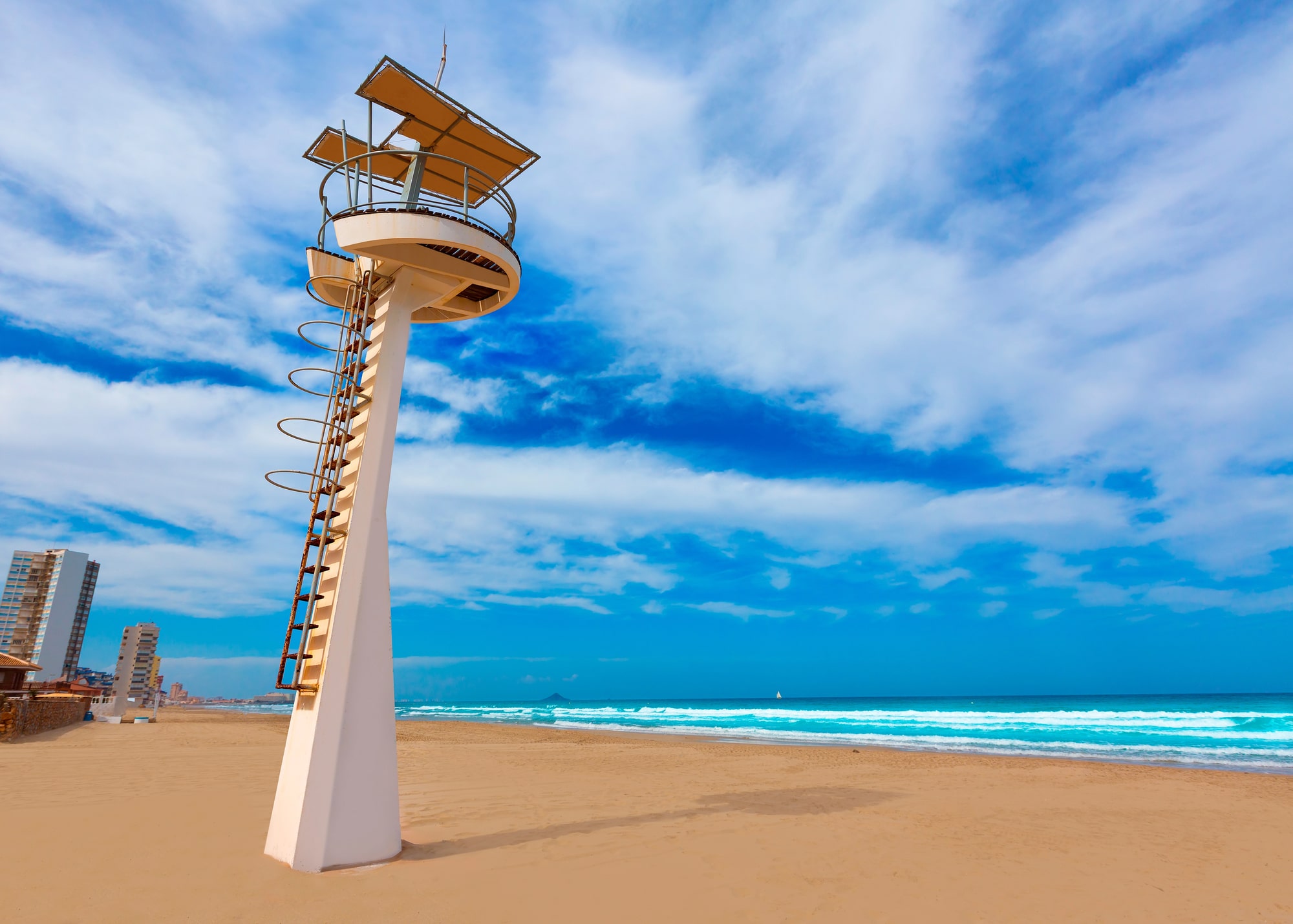
La Manga is a truly unique place with unusual nature and interesting infrastructure that is not grouped around one centre but stretches for some twenty kilometres along the main street. Like any area, La Manga has its pros and cons. The pros include:
- Two seas. This is a unique kind of holiday: you can swim in the open Mediterranean and then, literally two steps away, relax in the warm, salty waters of the lagoon. We have already mentioned the beautiful sunrises and sunsets over the water.
- Family holidays. The shallow, warm water of the Mar Menor suits children: parents can feel at ease even with the youngest ones. There are also plenty of activities and playgrounds for children.
- Sport and active leisure. La Manga has diving and sailing schools, organised excursions, and boats and yachts for hire with or without a skipper.
- Climate. The Costa Cálida, the coast of the Region of Murcia, is just as warm as the neighbouring Costa Blanca. The swimming season runs from May to October, and even in the winter months you can happily sunbathe on the beach, if not swim.
- Resort amenities. The long coastline lets you choose a beach to suit any taste: lively or secluded, on the Mediterranean side or on the Mar Menor side. Along the Gran Vía, La Manga’s main street, there are countless bars, cafés and restaurants. Excellent fish restaurants can also be found around Cabo de Palos, drawing fish and seafood lovers from all over the region.
The cons of La Manga include:
- Seasonality. La Manga remains a seasonal area, busy in summer and almost deserted in winter. So in the low season, when many bars and restaurants are closed, some people may find it dull to spend time there.
- Urbanisation and visual “density”. Not everyone likes the high-rise development on the spit; the press regularly discusses renovation, redevelopment and the demolition of outdated buildings to improve the area’s appearance.
- No town centre. In La Manga, neighbourhoods and amenities are strung out along the spit, and there are none of the usual squares and parks.
Property in La Manga

In September 2025, the average price per square metre of housing in the Region of Murcia was €1,555. In La Manga, a square metre cost €2,153, and annual price growth reached an almost record 15.5%. In September, prices in all areas of La Manga hit all-time highs: demand for property in this part of the Costa Cálida is rising along with its popularity and tourist numbers.
La Manga is roughly divided into five areas, with almost no difference in price between them: resale homes are offered at €2,066 to €2,368 per square metre. Long-term rentals cost €11.5 to €16.2 per square metre.
The cheapest one-bedroom apartments in La Manga start from €80,000. And it is worth saying straight away that almost all property here has a sea view, of either the Mediterranean or the Mar Menor. The exceptions are apartments on the lower floors of developments that look onto the inner grounds. Three-bedroom apartments cost from €125,000, and townhouses and bungalows from €150,000. Prices for detached houses start from €330,000, and for villas from €500,000. New one-bedroom apartments direct from the developer are offered from €288,000.
Would you like to buy property in La Manga? See the best new-build developments in our catalogue.