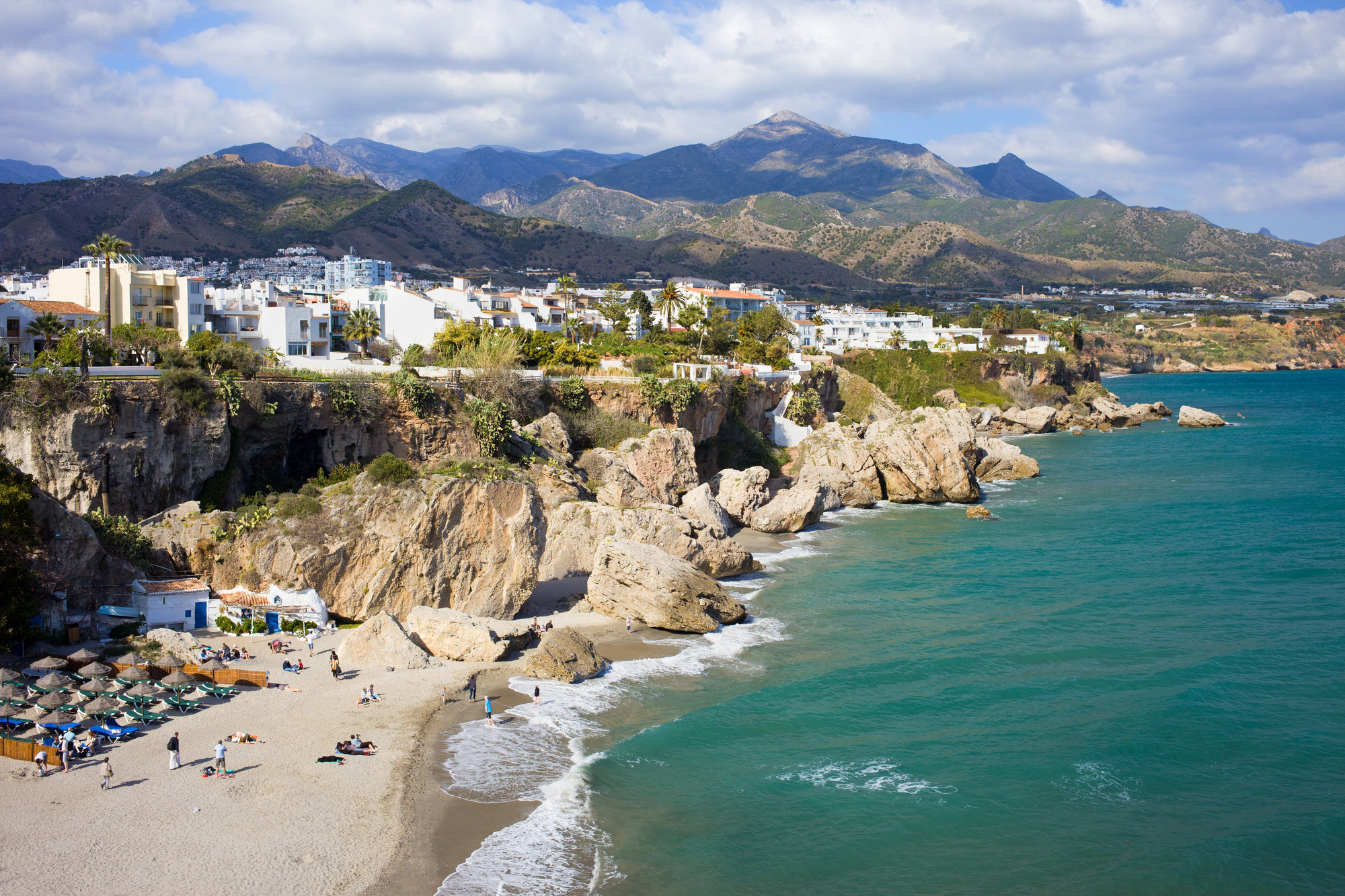
Nerja is a small, picturesque Mediterranean resort on the Costa del Sol, just east of Málaga. If you have read articles about Andalusia, you have probably come across the phrase “white village” (pueblo blanco) more than once: dozens of Andalusian municipalities fit this description, with their houses painted white, which contrasts so beautifully with the bright blue Spanish sky and the deep green of the hills. Nerja is a typical Andalusian white village, with views that seem made for tourist postcards. To be fair, this “village” is quite large, more of a small town: in 2024 the number of registered residents exceeded 22,000, of whom almost 6,000 are foreigners. At the height of summer and the holiday season, this figure grows several times over.
Nerja lies in a very picturesque setting, at the foot of the Sierras de Tejeda, Almijara y Alhama Natural Park. The snow-white town spreads along a narrow strip of coast, climbing in terraces up the hills that close in on it.
How to get to Nerja
Nerja is 58 km from the centre of Málaga, the capital of the province of the same name, and 70 km from the international airport. So the easiest way to reach Nerja is by air. But if you prefer, you can also travel to the Costa del Sol by rail: in the centre of Málaga there is a large railway station served by, among others, AVE high-speed trains from Madrid. The journey to or from the Spanish capital by high-speed train takes about 2.5 hours. From Málaga to Nerja you can go by taxi or by bus. The bus journey takes from 50 minutes (non-stop services) to 1 hour 45 minutes (services with stops) and costs on average €5 to €8.
Nerja also has direct bus links with Madrid, Almería, Córdoba and Granada. And from the port of Málaga you can take a passenger ferry to Melilla, a Spanish enclave city on the African continent.
Distances from Nerja to the nearest towns and resorts:
- Benalmádena: 82 km;
- Fuengirola: 91 km;
- Granada: 94 km;
- Marbella: 117 km;
- Puerto Banús: 124 km;
- Estepona: 147 km;
- Almería: 154 km;
- Ronda: 160 km;
- Gibraltar: 196 km.
History of Nerja
Like that of many other Andalusian towns, the history of Nerja goes back centuries. The coast of today’s Costa del Sol has been inhabited since ancient times. Scientists date the oldest archaeological finds to the Palaeolithic. In the famous Nerja caves, discovered in 1959, cave paintings and artefacts were found, evidence of human presence in this part of Spain in prehistoric times.
A permanent settlement on the site of Nerja appeared in the time of the ancient Romans, around the 1st century BC, and was called Detunda. After the fall of the Roman Empire, the Visigoths came to these lands, and in the 8th century they were replaced by the Moors. It was during the period of Muslim rule that the southern part of present-day Spain received its strongest boost to development: towns were built and fortified, the arts and crafts flourished, especially architecture, there was lively trade with other lands, and agriculture grew and strengthened. Nerja did not stand aside. The settlement was renamed Narixa, meaning “abundant spring” or “fountain”. For the local people, it was a time of economic prosperity: agriculture, crafts and trade flourished, and new residential quarters were built. The Arab heritage can still be felt in the architecture and layout of the historic part of the town.
The Christian period in Nerja’s history began in 1487, after the Reconquista, when the town passed to the Crown of Castile. Nerja continued to grow and develop: in the first centuries of Christian rule, new churches and public buildings were erected.
An economic decline set in during the 19th century, caused by severe epidemics and the decline of agriculture. The situation was put right by the opening of a sugar factory in 1882. Nerja’s modern heyday began in the middle of the last century with the development of tourism, construction and services. Today Nerja is a popular tourist destination. It attracts those who want to holiday close to Málaga and its fashionable resorts, while staying away from the noise and traffic of the big cities.
Nerja: weather and climate
Nerja has a mild Mediterranean climate. In winter, the average daytime temperature in this part of the Costa del Sol reaches about 15.6 °C, dropping to 8-10 °C at night. In summer, daytime temperatures usually stay around 29.5 °C, and around 22 °C at night.
The sea off Nerja warms up quite well: the influence of the cold Atlantic waters entering through the Strait of Gibraltar is felt a little less here. In the summer months the water temperature ranges from 22.8 °C in July to 24.5 °C in August, which makes swimming very pleasant.
The Costa del Sol is the sunniest coast in Spain. Rain is rare here, and rainy spells last only a few days. Most of the rain falls in the autumn and winter months. In summer it is minimal, and in July and August Nerja often has no rainy days at all.
Beaches of Nerja
Nerja’s coastline is 13 km long. Its main feature is its crystal-clear water. In total, the municipality has 17 beaches:
- Playa de Burriana: the liveliest town beach, with excellent facilities. Besides swimming, you can enjoy various sports and activities here: jet skis, ringos, banana boats, parasailing and more. Nearby there is a seafront promenade and a variety of bars and restaurants.
- Playa de Carabeillo: a small cove reached via the “Mirador del Bendito” viewpoint on Calle Carabeo. With its lush vegetation, the beach looks like a tropical island, secluded and very picturesque.
- Playa de Carabeo: a small but very lively beach that gets very busy. It lies in a small cove sheltered from the wind by rocks.
- Playa del Chorrillo: a chain of three small coves with tiny beaches. Snorkelling and diving enthusiasts come here.
- Playa de Calahonda: a beautiful beach at the foot of the famous “Balcón de Europa” viewpoint. The beach is well equipped and close to the town centre.
- Playa de la Caletilla: a small cove next to the Balcón de Europa hotel.
- Playa el Salón: a beach in the old fishermen’s quarter, where fishermen’s huts and houses still survive and are now used as summer homes.
- Playa la Torrecilla: another busy beach, very popular with tourists and close to the town’s best restaurants.
- Playa el Chucho: a beach stretching from the ruins of the old Torrecilla de Nerja watchtower to the mouth of the Chíllar river. The seabed here is stony, so it is best to wear water shoes.
- Playa el Playazo: Nerja’s longest beach, a popular spot for family holidays. All the boats and small motor boats also land here, as the town has no marina of its own.
- Cala Barranco de Maro: a very secluded cove at the mouth of the Barranco de Maro stream.
- La Caleta de Maro: a lovely cove considered one of the most beautiful in Nerja. The beach is small, so in high season it can be hard to find a free spot.
- Playa de Maro: a beach in a protected area about 4 km from the town centre. Fishing is banned here to preserve the underwater ecosystem.
- Playa Molino de Papel: a secluded wild beach near an old paper mill.
- Playa de las Alberquillas: another wild beach surrounded by picturesque cliffs.
- Cala del Pino: a cove with crystal-clear water, suitable for snorkelling and diving. It is a favourite spot of naturists.
- Playa el Cañuelo: a partly naturist beach known for its underwater caves.
Nerja’s historic centre and sights
Nerja’s historic centre is a web of charming narrow streets that wind between the walls of snow-white houses and lead here and there into picturesque squares. The centre of Nerja is a fine example of Andalusian architecture.
The town’s main sight is the magnificent “Balcón de Europa” viewpoint with panoramic views, built on the site of a former military bastion. It offers breathtaking views of the Mediterranean and the surrounding beaches. The viewpoint was given its name in 1885 by King Alfonso XII during his visit to the town, which had been hit by a devastating earthquake.
Next to the “Balcón de Europa” stands the Church of El Salvador (Iglesia El Salvador), built in the 17th century in the Baroque-Mudéjar style. Inside you can see frescoes believed to be by Francisco Hernández. Another religious sight of Nerja is the hermitage of Our Lady of Anguish (Ermita de Nuestra Señora de las Angustias), the town’s patron saint, dating from the 16th century.
On the outskirts of the town stands the 72 m long Eagle Aqueduct (Acueducto del Águila), built in the Coladilla de Cazadores gorge in the 19th century to supply water to the San Joaquín de Maro sugar factory, the very one that helped the town survive the economic decline. This majestic piece of engineering has four tiers of arches and is still used to irrigate the fields. In 2012 it was fully restored and is in excellent condition, which cannot be said of the factory building, which is gradually falling into ruin.
Another local sight is the old Maro watchtower (Torre de Maro), built back in Moorish times and used as a lookout over the Mediterranean and the surrounding land. The tower offers a panoramic view of the coast, which made it a strategically important point for the defence of the region. After the Reconquista the tower kept its guard role, passing signals about possible attacks to other watchtowers. The system of watchtowers along the coast was needed for protection against the Barbary pirates, who in the 16th and 17th centuries often raided coastal settlements, keeping the local people in constant fear. Today the Maro tower is a historic monument and a popular tourist attraction.
Nerja’s natural attractions
In the eastern part of the municipality lies the Maro-Cerro Gordo protected area, which offers beautiful views of the whole coastline, its beaches and picturesque coves.
To the north is the Sierras de Tejeda, Almijara y Alhama national natural park, with numerous walking and cycling routes. The park is full of secluded corners, small waterfalls and natural pools, and its highest points offer beautiful views of the coast. The park lies on the border of the provinces of Málaga and Granada and covers an area of more than 40,000 hectares. This mountain massif includes three main ranges: Tejeda, Almijara and Alhama. The highest point is La Maroma peak, at 2,065 m above sea level.
Over many thousands of years, erosion has formed deep gorges and canyons. The valleys and lower slopes are covered with pine forests, but the higher you go into the mountains, the more oaks and maples you find. Of particular interest is the yew grove, one of the southernmost in Europe, on the slopes of Salto del Caballo. The variety of ecosystems supports a rich diversity of species in the area.
The Nerja Cave
The Nerja Cave (Cueva de Nerja), 4 km from the town centre, is one of the main sights not only of Andalusia but of the whole of Spain. This impressive cave in the Maro area was discovered by chance on 12 January 1959 by a group of teenagers looking for bats. Just a year and a half later, it had already been recognised as an important site of Spain’s historical and cultural heritage.
Archaeological research has shown that the cave is 5 million years old. For many thousands of years, from the Palaeolithic to the Bronze Age, it was used by people. This is shown by numerous valuable historical finds: cave paintings of animals and abstract symbols, traces of hearths, remains of stone tools and fragments of pottery.
The cave consists of several galleries and halls: the Hall of Ghosts, the Hall of the Waterfall, the Bethlehem Hall, the Hall of the Cataclysm, the Hall of Spears and several more. At the opening ceremony on 12 June 1960, the Tour de Paris ballet performed in the Hall of the Waterfall (Sala de la Cascada). This performance gave rise to the Cueva de Nerja music festival, which is still held today. The Hall of the Waterfall can hold 100 spectators; over the years world-famous artists have performed here, including Mstislav Rostropovich and Maya Plisetskaya. The discovery of the Nerja Cave changed the life of the town radically: from a settlement living mainly from farming and fishing, it became a centre of tourist interest.
The chain of galleries and halls is about 750 m long, with a height difference of about 68 m. The cave covers an area of about 35,000 m². A small part of the halls is closed to visitors, so the tourist route is just under 550 m long. All along the route you will see stalactites and stalagmites of the most incredible sizes and shapes. The Hall of the Cataclysm (Sala del Cataclismo) stands out in particular: it holds the world’s largest stalagmite column, 60 metres high, listed in the Guinness Book of Records.
The Nerja Cave has the status of a historic and artistic monument, a Spanish geological site of international importance and a cultural heritage site. Next to the entrance to the cave lies the modern Detunda-Cueva de Nerja botanical garden, which displays native plant varieties of the coast and the nearby mountains. The park’s viewpoint offers a beautiful view of Nerja and Maro.
Property in Nerja
In December 2024 the average price per square metre of resale housing in Nerja was €3,403. Over the year, prices rose by 3.1%. For comparison: a square metre costs on average €2,244 in Spain, €2,283 in Andalusia, €3,468 in the province of Málaga and €3,215 in the city of Málaga itself.
The most expensive area of Nerja is Chaparil – Torrecilla – Punta Lara, on the border with Málaga. Here homes cost on average €4,042/m². The most affordable area, Almijara, is in the north of the municipality: here you can find property at €2,537/m².
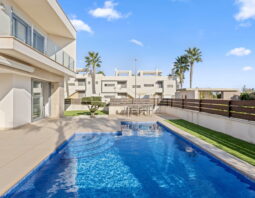
Prices for residential property in Nerja start from €140,000. For this money you can buy a studio or a small one-bedroom apartment. With a budget of €170,000 you can expect to buy a two-bedroom apartment. Prices for townhouses start from €185,000, for detached houses from €285,000, for villas from €585,000 and for country mansions and luxury villas from €1,200,000.
There is new-build construction in Nerja. Directly from the developer, two-bedroom apartments can be bought from €226,000, three-bedroom apartments from €340,000, semi-detached houses and townhouses from €550,000 and detached houses from €1,095,000.
If you would like to buy property in Nerja, browse the best properties in the town and its surroundings in our catalogue.