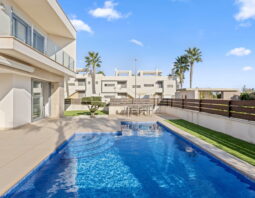
Manilva is a small resort town just west of Estepona. Manilva is a remarkable place: there are no high-rise buildings, no heavy tourist traffic and no architectural landmarks, yet the town has a unique charm and appeal. The historic centre, 2 km from the sea, is surrounded by green vineyards. Closer to the coast the vineyards give way to golf courses that reach almost to the water’s edge. Here and there the green landscape is dotted with white urbanisations built in the classic Andalusian style.
Population and climate of Manilva
Manilva has only 28,000 residents, 6,500 of them foreigners. Needless to say, British nationals take first place among the foreigners (almost 40%). And no wonder: people choose Manilva for its beauty, comfort, excellent infrastructure and superb beaches that stay uncrowded even at the height of summer. And, of course, the town’s appeal is enhanced by two magnificent golf clubs: Doña Julia Golf Club and La Duquesa Golf.
Small in area (only 35.5 km²), Manilva has its own marina and several excellent beaches lined with fish restaurants ready to offer you any delicacy from the fresh catch.
Manilva has a distinctly Mediterranean climate with hot summers, mild winters and very little rainfall. A high mountain range shields the town from cold Atlantic air masses to the north-west, so the average annual temperature stays at a comfortable +18ºC. The swimming season lasts from May to October, and the water is warmest in August (up to +25ºC).
Manilva: location and transport links
Manilva lies halfway between Estepona and Sotogrande, about 10 km from Los Alcornocales Natural Park. This is the westernmost part of the Costa del Sol, where it gradually merges into the Costa de la Luz.
Distances from Manilva to the nearest points of interest and airports:
- Málaga Airport: 95 km;
- Gibraltar Airport: 35 km;
- Gibraltar: 38 km;
- Sotogrande: 17 km;
- Estepona: 14 km;
- Benahavís: 35 km;
- Puerto Banús: 34 km;
- Marbella: 46 km;
- Fuengirola: 76 km;
- Benalmádena: 87 km;
- Málaga: 104 km.
By car, Manilva is easy to reach from the nearest airports via the A-7 (the toll-free section of the Mediterranean motorway E15) and the AP-7 (the toll section of the E15). The A-377 road also passes through Manilva.
Manilva also has public transport: taxis and a town bus linking the administrative centre with all the large urbanisations and the coastal area. In addition, intercity buses make it quick and easy to get from Manilva to Estepona, Marbella, Algeciras and the international airports of Málaga and Gibraltar.
The nearest railway line to Manilva runs through San Roque, a municipality in the province of Cádiz only 26 km to the south-west. The large passenger ports are in Tarifa and Algeciras.
History of Manilva
Like many resorts on Spain’s Mediterranean coast, Manilva grew out of a small fishing village.
The part of the coast where the municipality lies was inhabited by ancient people as early as the Stone Age. Agriculture, crafts, trade, fishing and fish salting began to develop actively with the arrival of the Romans. The remains of Roman baths and a fish-processing factory have survived in the village of Castillo de la Duquesa.
Manilva emerged as a proper village in the 16th century. Until the end of the 18th century it was administratively subordinate to Cádiz, and in 1795 it gained its independence.
Today Manilva is not only one of the most important resorts on the Costa del Sol but also a wine-growing area. Vineyards spread across the countryside around the town, growing mainly the Moscatel grape, which is used to make sweet white wines.
Sights of Manilva
Manilva’s main sight is the Duchess’s Castle, Fortín de Sabinillas, a historic building constructed in the 18th century as a defence against pirates. For several centuries the entire Mediterranean coast of Spain suffered from frequent and devastating raids by Berbers and corsairs, so building watchtowers and castles that could house permanent garrisons became the main task of local rulers. Until recent times the castle served as barracks for the local carabineros and the Guardia Civil. Today it has been turned into a museum, and its viewing platform offers a beautiful view of the town and the coast.
The castle houses the Archaeological Museum of Manilva, whose collection includes all the finds made at the site of the ancient Roman settlement Entorno del Castillo de la Duquesa, dating from the 1st century BC to the 5th century AD.
Be sure to visit the parish church of Santa Ana, built in the 18th century in the Neoclassical style, as well as the elegant white chapel of the Virgen del Carmen, right on the shore near the castle.
Wine lovers will appreciate the wine collection and tasting programme at the Nilva bodega, which produces excellent white wine from local grapes.
And, of course, Manilva is known for its well-equipped La Duquesa marina and its many fish restaurants, able to satisfy the most demanding visitors.
Beaches of Manilva
Manilva has 8 km of sandy beaches with gently sloping entry into the sea and good facilities. The best beaches in the municipality are:
- Playa de Punta Chullera: a semi-urban beach 700 m long, made up of a series of small sandy coves separated by rocky stretches. It is famous for its crystal-clear water. Very popular with spearfishing enthusiasts. Sunbeds and parasols are available for hire on the beach.
- Playa de La Duquesa: the main town beach, 1,600 m long, which near the port gradually turns first into the sand-and-shingle El Castillo beach and then into Las Gaviotas beach. Very well equipped, it receives Blue Flags every year for cleanliness and facilities.
- Playa de Sabinillas: another very well-equipped town beach, 1,700 m long, north of the marina in the resort area of San Luis de Sabinillas. Numerous bars and fish restaurants line the beach.
- Playa El Negro: a sandy semi-urban beach 1,300 m long with several bars and sunbeds and parasols for hire. Not far from the beach is the spa resort Hotel Suites Duquesa Golf & Spa. The beach is popular with anglers: throughout its long history it was used for setting traps and catching tuna.
- Playa Las Arenas (El Gobernador): a semi-urban beach 1,000 m long with coarse grey sand and easy entry into the sea.
- Playa Los Toros: the westernmost semi-urban beach, 1,300 m long, clean and uncrowded even in high season. This is the last beach of the Costa del Sol: right after it begin the province of Cádiz and the Costa de la Luz. The beach takes its name from a nearby track along which cattle were driven to Estepona in the old days.
Around Manilva: things to do
Those living or holidaying in Manilva have all the attractions of the Costa del Sol at their disposal: from shopping in Puerto Banús to the amusement and theme parks of Torremolinos, Benalmádena, Marbella, Mijas and Fuengirola.
There are also several magnificent natural parks near Manilva: Los Alcornocales, Sierra de Grazalema, Sierra de las Nieves, Los Reales de Sierra Bermeja and others. If you enjoy mountain biking, hill walking or climbing to the summits, organising an active holiday will be easy. All the parks have numerous trails of different lengths, designed for beginners and experienced athletes alike. And the parks’ viewpoints offer panoramic views of the Costa del Sol, the Costa de la Luz and neighbouring Africa.
10 km from Manilva, Sotogrande has an International Tennis Academy and a modern tennis club, as well as a riding school. And from the passenger ports of Algeciras and Tarifa you can take a ferry to the Spanish enclave of Ceuta and to Morocco.
Property in Manilva
The average price per square metre of housing in the province of Málaga in November 2023 was €3,051, 10.7% higher than in November 2022 and 1.6% higher than in August 2023. Manilva shows below-average figures: €2,152, 2.2% and 2.7% respectively, so buying a home in the town looks financially attractive.
For comparison, here are the prices in neighbouring Estepona and Sotogrande, 10 km to the east and west:
- Estepona: €3,228/m², annual price growth 11.8%, quarterly price growth 2.5%;
- Sotogrande: €2,964/m², annual price growth 12.1%, quarterly price growth 4.4%.
Across the main districts and urbanisations, property prices are as follows:
- Manilva: the largest district and the administrative centre, some distance from the sea. Housing here costs €2,115/m² on average.
- Chullera and Playa Paraíso: the westernmost district, on the border with the province of Cádiz. Price per square metre: €2,783.
- Alcorrín: a relatively inexpensive district, where the price per square metre of housing in November 2023 was €2,229.
- El Castillo: a prestigious district with an excellent beach and Manilva’s main sights. Housing here costs €2,718/m² on average.
- Puerto de la Duquesa: the smallest district, spread around the marina. Property here is in high demand, and as a result prices stay fairly high, at €2,974/m².
- La Duquesa: the least expensive district, where you can buy a home for €2,075/m².
- San Luis de Sabinillas: the easternmost district of Manilva, on the border with the neighbouring municipality of Casares. Housing here costs €2,186/m² on average.
Property prices in Manilva start from €65,000 for small apartments. Bungalows, townhouses and small semi-detached houses can be bought from €115,000. A detached house with a small plot can be found from €325,000. Spacious country houses and small villas in Manilva cost from €500,000, and a luxury villa from €1,000,000.
New building is under way in Manilva along the coast. Most of the new builds are modern apartment developments with spacious terraces, sea views, large gated grounds and pools. Prices for apartments direct from developers start from €141,000.
You can browse property for sale in Manilva in our property search.