When property in Spain is being chosen for pensioners, preference is usually given to inexpensive options that do not cost much to maintain.
When choosing a property, you need to take the buyer’s mobility into account: having your own car widens the search and lets you include out-of-town urbanizaciones (residential estates); without a car, you will have to favour properties in town. Public transport runs well only in large cities, and in small resort towns and villages you should not count on it.
Not having a car in a resort area means you will have to walk to all the essential services and amenities. That is why we recommend getting to know the town and its neighbourhoods in advance and finding out where the supermarkets, pharmacies, health centre and hospital are.

For many pensioners the distance from the home to the beach will also matter: in the summer heat, even a 1 km walk can be hard going. And if the area is hilly, even a shorter distance will not help.
Having your own transport means you do not have to limit your search to busy central areas and can also consider urbanizaciones on the outskirts or outside the town. The advantages of these estates are peace and quiet and their own grounds with a children’s playground, sports courts, a pool and so on. You will find more information in our guide “Types of property in Spain”.
You can find our tips on choosing a home in the article “Property in Spain for permanent living: a buying guide”.
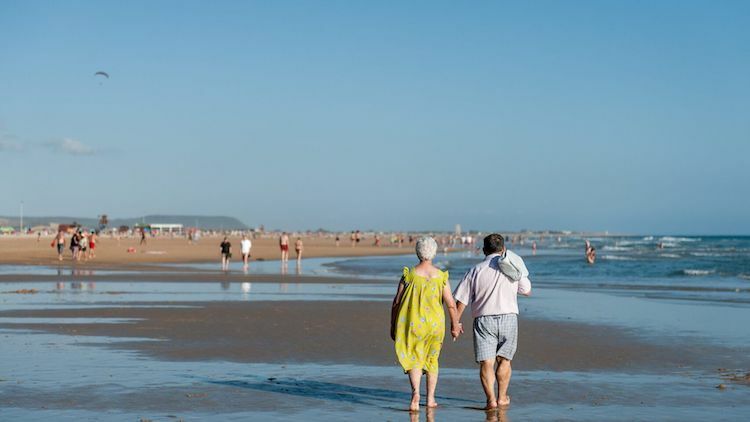
Homes on the Costa Blanca (province of Alicante, Torrevieja), the Costa Cálida (Region of Murcia) and the Costa de Valencia (province of Valencia) are traditionally in high demand.
Property in Spain for pensioners is an affordable option that is at the same time comfortable and does not involve major costs. That is why we do not recommend buying a studio, and instead suggest looking at apartments with one or two bedrooms, as well as bungalow apartments with their own entrance and a patio or terrace. You can get an idea of prices for Spanish homes by reading our article “Property in Spain by the sea: prices in 2020”.
To buy property in Spain as a pensioner, you will need to open an account with a Spanish bank and transfer the full amount required to it. The bank will always ask for documents proving that the funds are legal.
You also need to obtain an NIE number before the purchase; it serves both as your foreigner identification number and as your tax number. The NIE can be obtained on the basis of the reservation contract from the police in Spain itself, or at the Spanish consulate in the buyer’s country of residence.
Property bought in Spain does not oblige pensioners to obtain a residence permit: they may come to the country on a multiple-entry visa and stay up to 90 days in every six months. But if they wish, they can move to Spain permanently, as we explain in the article “Residence permit in Spain when buying property”.
We should note straight away that a Spanish residence permit obtained in this way does not give the right to work, nor does it give access to public healthcare. So you will have to take out private health insurance, which for pensioners means substantial additional costs.